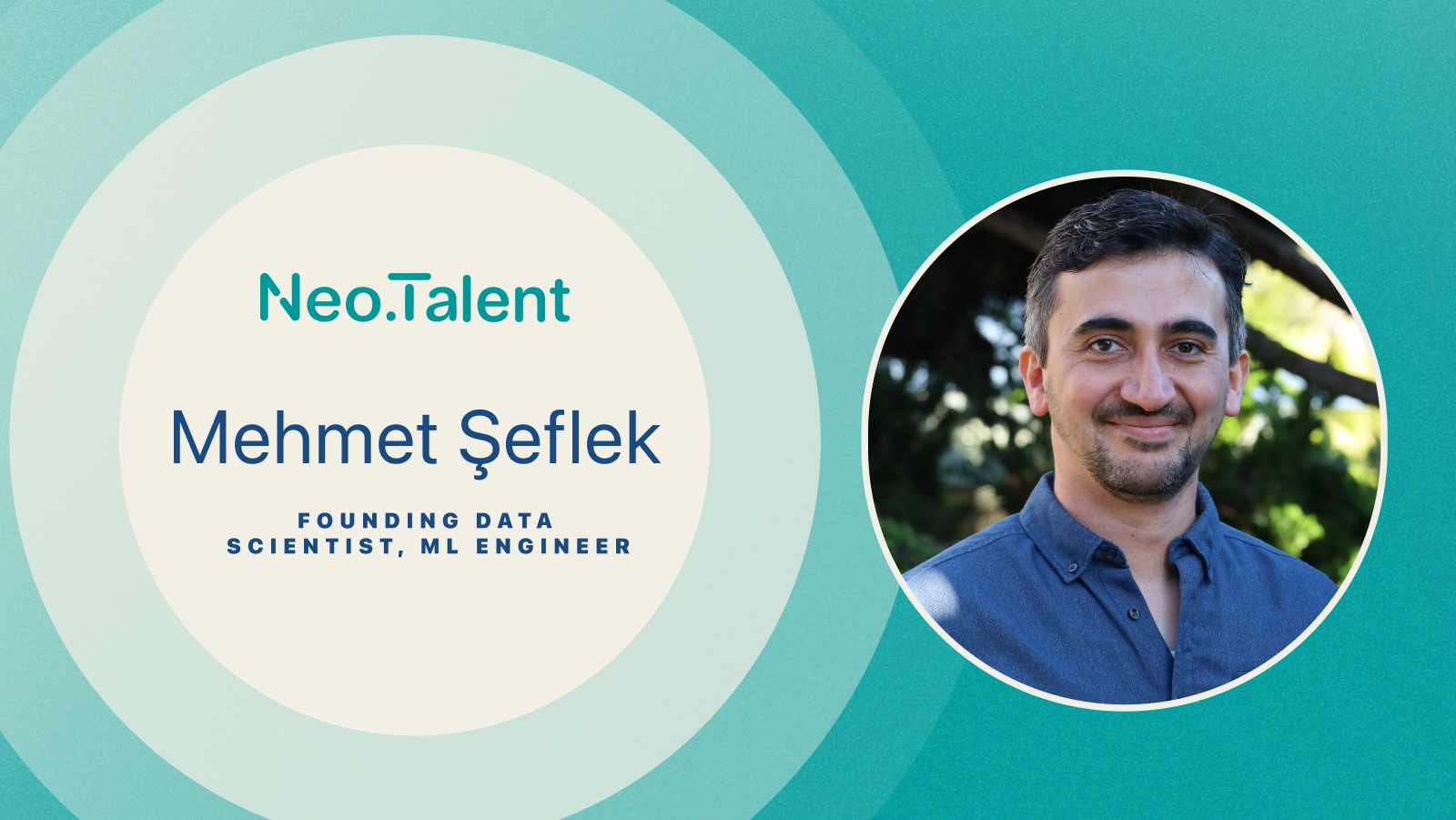
Mehmet Şeflek never planned on working in machine learning or in tax. He studied economics at the University of California, Berkeley, went on to the Kennedy School at Harvard for a Master’s in public administration, and returned to Berkeley for a Ph.D. in business economics. He was drawn to a particular kind of question: how companies actually work on the inside. “I was fascinated by the economics of the firm. Why companies organize themselves the way they do, how all the moving parts fit together,” he says. “It’s the thing I always came back to.”
By the time he was deep into the Ph.D., though, the pull had shifted from studying companies to building. “I realized I liked building out of data a lot more than I liked writing about it,” he says. So he took a role at a health-tech startup, and not long after, an old friend, Neo.Tax cofounder Ibrahim, reached out about a company he’d just founded.
The pull toward business wasn’t new. “I come from a family of small-business owners, in Türkiye and here in the U.S. I grew up around the realities of running a company: payroll, accounting, taxes, long before I ever studied any of it formally,” Mehmet says.
That fascination with the firm is also what drew him to tax. “There’s no more intimate representation of a company than its taxes,” he says. “To file correctly you have to understand every transaction, every project, how the whole organization spends its time and money. If you want to model the inner workings of a business, tax is about the richest picture you’ll find.”
Helping Build Neo.Tax
Mehmet joined in 2020, when the team was just getting started, helping build the machine-learning platform Neo.Tax would grow on. The company started with R&D credits for startups; within a few years, the LLM-powered tool was handling ASC 350-40 and R&D credits for enterprise companies.
Coming at engineering from economics rather than a pure computer science track gave Mehmet a different way into the problem. “Econ and ML are basically the same instinct,” he says. “You take a messy pile of data and pull out a decision you can defend. Tax just turned out to be that problem in a particularly demanding form.”
The fit was obvious to him: tax is a vast body of rules applied to an even vaster pile of company data, exactly the conditions where machine learning earns its keep. “I was the first full-time hire, so I built the whole machine-learning function from basically nothing, and stayed long enough to watch it survive contact with the real world at scale,” he says. “And the field changed completely underneath me. We went from hand-curating datasets and training models from scratch to fine-tuning LLMs trained on the entire internet. The entry cost to a working model collapsed; now you can point an LLM at a problem and get to a starting point in an afternoon.”
But a plausible-sounding output is not the same as a correct one, and that gap is exactly where Mehmet’s work lives. “That’s the trap with these models,” he says. “The output comes back fluent, confident, well-formatted, and it looks like an answer. Then you dig into it and realize a good chunk of it is nonsense. The polish is the dangerous part, because it’s what stops people from checking.”
Skepticism as an Unfair Advantage
It’s a problem he’s unusually equipped to catch. Trained as an economist, his instinct is to distrust any number until he knows how it was produced. “It’s easy to get wowed by the latest model from Anthropic or OpenAI,” he says. “But the question I come back to is: how would we even know if it’s wrong?” In tax, where being wrong carries real consequences, that means building systems that interrogate not just whether an answer is right, but how the model arrived at it. “And you only build that instinct working somewhere where the cost of being wrong is real.”
These days, that conviction is pulling Mehmet deeper into the engineering itself. Lately he’s been building out the infrastructure that lets models like these run at scale. It’s the part where his two worlds meet. “In economics, a theory or an empirical result can be beautiful on paper and still fall apart the moment it hits real-world budgetary, implementation, and time constraints,” he says. “Inference engineering feels like that. The model is the theory. Making it run fast and cheap and reliable enough that people can depend on it is the policy implementation. That’s where it either works or it doesn’t.”
The tech world is still sometimes thought of as a place where move fast and break things is the law of the land. But tax is different — a hallucinated output that leads to an audit can break a client’s trust in your tool forever. So, to build an AI-powered tool that can revolutionize the tax space, you need to start from a place of skepticism and move with the diligence of a scholar.
Luckily for Neo.Tax, Mehmet Şeflek is Neo.Tax’s founding data scientist and machine learning engineer.